A new analysis presented in this report, based on 3,800 coal-fired power plants in 71 countries, finds that areas located downwind of coal plants tend to experience higher levels of pollution and be poorer than upwind areas. Thus in countries rich or poor, lower-income groups are affected disproportionately by air pollution. This finding could reflect the fact that poorer people locate in neighborhoods where higher pollution lowers the price of land. It also could be a consequence of the health impacts of air pollution, which are known to lower labor productivity, cognitive performance, and incomes. Although subsidies are harmful, simply removing them may not be sufficient to tackle pollution. The report estimates that a US$0.10 per liter increase in the average annual retail price of common transport fuels (for example, diesel) may be associated with a decrease of 2.2 μg/m3 in the average annual concentration of PM2.5 in capital cities.2 While a notable improvement, this reduction makes barely a dent in cities such as New Delhi that have annual average PM2.5 concentrations upward of 150 μg/m3. Removing explicit fossil fuel subsidies could reduce PM2.5 concentrations enough to prevent about 360,000 deaths between now and 2035—a large number, but only a fraction of overall deaths attributed to air pollution. The evidence points to the limits of price-based measures to curb pollution, as energy consumption is often price inelastic. A literature of more than 400 empirical studies
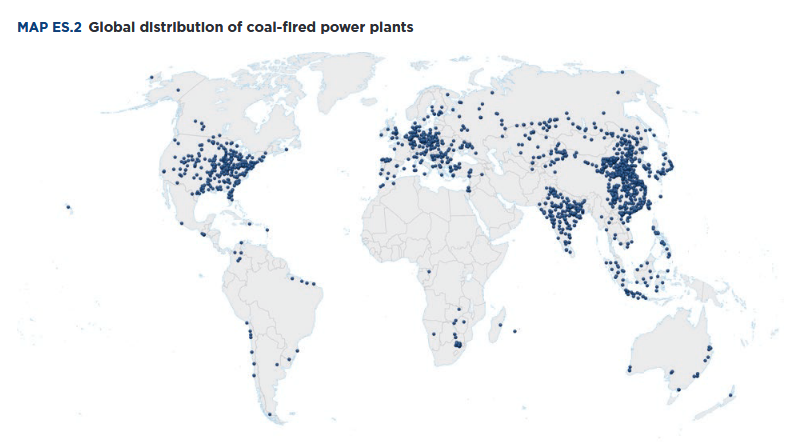
Source: Global Coal Plant Tracker (https://globalenergymonitor.org/projects/global-coal-plant-tracker/). Note: The map shows the spatial distribution of coal-fired power plants as of January 2013. Each dot denotes an operating unit. MAP ES 2 Global distribution of coal-fired power plants xxvi Executive Summary providing 2,000 estimates shows that energy consumption tends to be price inelastic, implying that the response of energy demand to price changes is sluggish. For instance, a meta-analysis conducted for this report suggests that, on average, a 10 percent increase in the unit price of energy results in a short-run reduction in consumption of 2.8 percent. This finding has important implications: removing explicit fossil fuel subsidies—albeit a necessary first step—is insufficient for solving the air pollution challenge. Moreover, since political reality imposes a limit on how far energy prices can be raised, complementary policies are needed to ensure the availability and affordability of clean alternatives, address information and capacity constraints, and influence behavior. Reforms of fossil fuel subsidies are typically pro-poor. By owning more cars and by heating and lighting bigger houses, the rich consume more energy and benefit dispropor- tionately from energy subsidy schemes. Hence the richest income group always loses more from the removal of subsidies than the poorest—on average, 13 times more in 19 countries examined in this report. And while conventional wisdom holds that subsi- dies constitute a larger share of the income of the poor, who therefore lose more from subsidy reform, the data offer mixed evidence. In simulations of subsidy reform con- ducted for this report, the richest income group lost on average 10 percent more, as a share of their income, than the poorest group in most countries.
Source: World Bank Publications